Mayor Brandon Johnson is losing a top official who became a pillar in the city’s first line of defense against the Trump administration while holding one of the most sensitive and trusted positions in city government.
Mary Richardson-Lowry is stepping down from her role as the city’s corporation counsel after more than three years, Johnson told WBEZ. She is the latest and one of the last remaining original appointees to leave Johnson’s administration.
Richardson-Lowry, a seasoned attorney who came out of retirement to become the first Black woman to fill the role, will be replaced by Renee Hatcher, a career academic who is an assistant clinical law professor and legal clinic director at the University of Illinois-Chicago. Her appointment requires City Council approval.
Johnson rebuffed the idea that the change in leadership comes at an inopportune time, as the city juggles numerous high stakes legal battles and Johnson embarks on an uphill battle for reelection.
“This is the appropriate time to transition,” Johnson said in an interview. “As I prepare for a second term, [I’m] sending a real clear message to working people in this city that our work has just begun.”
In an interview with the Chicago Sun-Times, Richardson-Lowry said she’s not leaving because she’s afraid that Johnson will lose the election. She simply wants to go home.
“I de-camped back to Chicago to serve from Arizona. I left my husband and dogs behind to meet my service requirements. And it has come to a close,” she said.
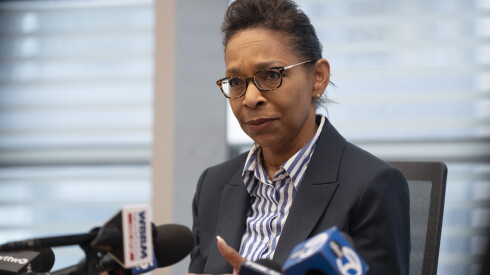
Chicago Corporation Counsel Mary Richardson-Lowry speaks during a news conference in 2025, where she discussed a proposed global settlement of $90 million for 176 police misconduct lawsuits involving former Chicago Police Department Sgt. Ronald Watts and his tactical team members.
Pat Nabong/Sun-Times
With Hatcher’s appointment, Johnson is also recasting the Law Department’s priorities, he said. The department is tasked with everything from defending police officers against misconduct lawsuits, to negotiating development contracts, to advising the mayor at City Council meetings.
But Johnson said he wants to see more affirmative litigation — a legal approach of proactively going after bad actors to protect consumers and residents from abuse. That’s largely how the Illinois attorney general operates.
“We have to be far more aggressive in protecting working people” because of the rise of “right-wing extremism,” he said.
“We’ve had to maintain a defensive posture in this season because of the federal overreach. But my vision going into my second term is to improve the quality of life for everyday people and to use the tools available to me… As affordability continues to be a challenge for Chicagoans and people across the globe, having a Department of Law that is aggressively thinking about how we can be more affirmative in our approach to provide economic justice for people.”
Johnson and Richardson-Lowry had already begun this approach. The mayor’s 2026 budget proposal grew the department’s affirmative litigation division by $530,000 and added five employees.
And the city sued Glock, Inc. in an attempt to hold the gun manufacturer accountable for selling pistols that can be converted into automatic weapons. Richardson-Lowry has also led or joined roughly 80 lawsuits against the Trump administration to stave off threats to cut hundreds of millions of dollars in federal funding.
Hatcher is the daughter of civil rights advocate and first Black mayor of Gary, Indiana, Richard Hatcher, who led that city for 20 years.
She has directed UIC’s Community Enterprise & Solidarity Economy Clinic for nearly a decade, overseeing student legal representation of worker-owned businesses, non-profits and small businesses that operate “for the benefit of an underserved community.”
Hatcher received her law degree from New York University. Before her clinic role, she held fellowships at the University of Baltimore and the Institute for Urban Policy Research & Analysis at the University of Texas. She worked as a staff attorney for the Chicago Lawyers’ Committee for Civil Rights for three years early in her career.
She steps into the role without any formal government experience.
But she told WBEZ she is “more than prepared” to lead Chicago’s $47.9 million Law Department and its roughly 330 employees.
“I don’t have the profile of a typical corporation counsel, but I actually think that’s a positive in this case — it’s not to say that I don’t understand how this works. I’m happy to answer any criticism with how I actually show up and do the job,” she said.
“My career has been committed to public interest law. I have tried to use lawyering as a means to improve communities and neighborhoods,” she said.
City attorneys are currently defending two of Johnson’s newly created revenue streams: a tax on social media companies and a licensing scheme for online sports betting. The city is also, with the state of Illinois, suing the Trump administration over Operation Midway Blitz. That’s on top of hashing out a major forthcoming global settlement for survivors of police torture.
Johnson called Hatcher a “quick study” and noted that Richardson-Lowry is “passing the torch” to who would be the second Black woman to hold the role.
But any mentorship would likely happen off-the-clock, as the formal overlap between the two on city payrolls will be almost non-existent. Richardson-Lowry’s last day is Oct. 1, the day Hatcher starts as interim corporation counsel.
Richardson-Lowry has fiercely defended Johnson and his policies since accepting the role in June 2023.
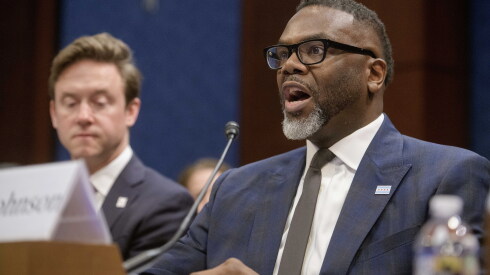
She publicly sparred with the city’s former Inspector General over access to investigate the mayor’s office. She sat behind Johnson through hours of testimony as he defended Chicago’s sanctuary city laws at a divisive and highly politicized Congressional hearing in 2025.
One of Richardson-Lowry’s biggest accomplishments was striking what one alderman at the time called the “deal of the century” — a $90 million global settlement that put to rest 176 lawsuits tied to former Chicago Police Sgt. Ronald Watts.
But the departing corporation counsel didn’t hesitate when asked what she wished she had done that she wasn’t able to accomplish.
“Well, of course there’s the Bears. That is the one that got away—for now,” Richardson-Lowry said of the Bears’ decades-long quest for a domed stadium now focused on Arlington Heights and Hammond, Indiana.
“For me, it is” a real regret, she said. “I want it for the city. I think it’s in the best interest of all parties concerned. And I think it remains an extraordinary opportunity if folks are willing. But, that is not a decision for the lawyer to make. It is a decision that all of the principals involved need to make. I remain hopeful. But it is for me, the one that got away.”