Evanston’s brand new Northlight Theatre was swinging on Friday night with the inaugural production “The Front Page,” written in 1928. The atmosphere pre-show was electric, and I had more than one patron make a comment to me in the drink line about how the space feels even bigger when teeming with people.
I admit I had reservations about choosing such an old-timey story to launch an exciting theater venue that has pledged to focus on new plays. So it was a pleasant surprise when the high-energy farce about a group of 1930s newspaper writers paired perfectly with the excitement of the audience in the new space.
The show, originally written by Chicago newspaper writers Ben Hecht and Charles MacArthur, offers a critique of “jazz-journalism” — the cutthroat style of reporting ushered in by an era of widespread political corruption. It covers the mob’s influence on Chicago’s City Hall, and the response of journalists who leaned into covering scandals with tabloid-rich, salacious stories.
The real life people who influenced the production are intriguing in their own right. They include Terrible Tommy O’Connor, a man sentenced to death for killing a cop. He allegedly escaped the gallows with a gun smuggled into the jail in a pork sandwich. Then there’s William “Big Bill” Thompson, the former mayor of Chicago, who a panel of historians in 1933 dubbed the most corrupt mayor in American history. And you can’t forget Peter Hoffman, the former Cook County Sheriff in the pocket of Al Capone who was infamous for allowing mobsters to take unauthorized nights off from jail.
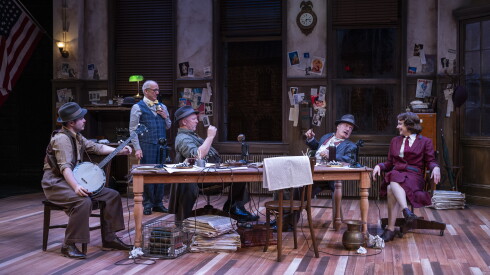
“The Front Page” fictionalizes these characters, among others, in a fast-paced, wise-cracking production that is equal parts hilarious and timely, as corrupt politicians are certainly not a thing of the past.
The entire play takes place in a press room, in which journalists from multiple publications operate out of a shared office inside Chicago’s Criminal Courts Building. Artistic director BJ Jones, who helmed this production, keeps the action humming even though both acts unfold in a single location. There is plenty of movement and at times it feels like a whirlwind of people in and out of doors, old ladies fainting, characters hiding in furniture, entrances and exits through windows.
Something is always happening, and the laughs are nonstop.
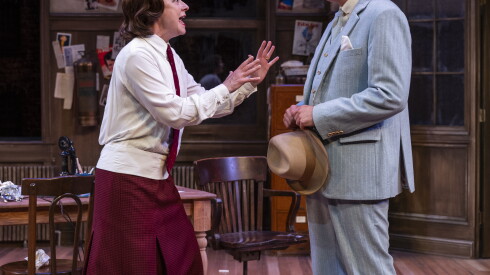
The show starts with a group of reporters playing poker, which is a nod to the true-to-life work culture of Hecht and MacArthur. Across the street, prisoner Earl Williams (John Drea, also seen in “Little Bear Ridge Road” at Steppenwolf and Broadway) is about to be hanged for murdering a cop. As the journalists are working the phones and preparing for the story — in these days, they didn’t actually write, but called the newsroom and verbally submitted the story — fellow reporter Hildy Johnson (Kate Fry) enters. She’s one of the best in business, but she announces her retirement, because she’s getting married and moving to Buffalo.
There are a few notable performances here, but Fry carries the show. Hildy is caught between two worlds: As a superstar reporter, she not only lands the big scoop, but she literally catches (and hides) the escaped killer. On the other hand, she’s ready for her next chapter, leaving the hustle bustle of the news biz to settle down with the stable accountant Brad Hefflefinger (Peter Moore).
Hildy is the central figure here, and Fry has a keen way of displaying her duality. In the newsroom, among the boys, she’s a tough-talking, sharp-witted pottymouth with talents that far exceed her peers. She often refers to herself, and is referred to by others, as a “newspaper man.” With Brad, she shows her soft side, and willingness to be a housewife, which her comrades enjoy poking fun at.
Underneath the hijinks, the play has a lot to say about political corruption and the need for people to speak truth to power. In one scene, Hildy’s editor, Walter Burns (Timothy Edward Kane, Fry’s actual husband), says, “The Chicago we love is being run by criminals and halfwits,” which earned a hearty groan from the audience.
Even with the stellar performance from Fry, I’m not completely sold by the script, adapted by Jeffrey Hatcher, nor am I convinced by Hildy’s ultimate decision to ditch the paper to “run the dishwasher.” The commentary on women in the workplace is there, and the story empowers Hildy to make her own choice while caught between two worlds, and two men (Walter and Brad), but it needed a touch more of a buildup for the ultimate payoff to fully satisfy.
Yet, this show works because it’s fun. And it places an ensemble of well known, and highly talented, Chicago actors center stage in a production that centers something Chicagoans absolutely love: Chicago. This is a great way to welcome area audiences into one of the local theater community’s newest playhouses.