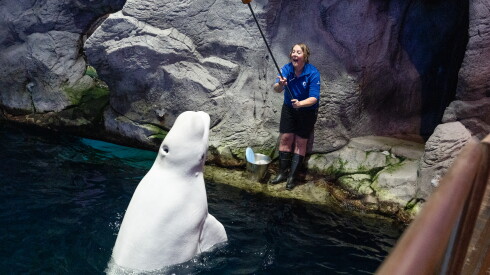
On a recent morning, Shedd Aquarium President and CEO Bridget Coughlin stood in front of a pool filled with six frolicking beluga whales, insisting that the institution, where five other whales have died in recent weeks, is not in crisis.
Coughlin, who has a doctorate in biochemistry, also pushed back against a growing public perception that the aquarium might have bitten off more than it could chew in adding 10 more belugas to a population of eight resident whales.
“Rescue is never convenient,” Coughlin said. “We have been truly rescuing these animals since January, when we sent the first staff up to Marineland [Canada in Ontario] to observe the animals, talk with Marineland staff, look at their records, watch their social groupings. So while to many it might have seemed recent, this has been a really diligent, multi-step process.”
Five aquariums, including four in the United States, agreed to take Marineland’s 30 belugas (at the time, the world largest population of captive belugas), after the park threatened to euthanize the cetaceans, saying the facility had run out of money to care for them. To date, six Marineland belugas have died since being moved: four at Shedd and one each at SeaWorld San Diego and Oceanografic Valencia in Spain. (A fifth Shedd beluga, Beethoven, was a resident whale and died Sept. 2.)
Much of the criticism for the transport out of Marineland has come from animal rights activists, who called the Canadian aquatic park’s threat to kill the belugas a “manufactured crisis” that effectively forced the Canadian government to approve shipping out the whales.
Largely forgotten in the drama of moving the whales — first in trucks and then in the cargo hold of a Boeing 777 — were the people left behind: the Marineland trainers. Because the park was sometimes understaffed, shifts often lasted 12 hours. The bond between animal and human became incredibly close, former staff there say, making the threat of euthanasia, the transports out and the eventual death of some whales deeply traumatizing.
Alysha Tullio, who lives in Ontario, spent four years working at Marineland, starting as a basic beluga caregiver, before becoming the lead trainer for two of the belugas that ended up at Shedd, including Sierra.
Tullio remembers the day Sierra was hoisted out of her pool at Marineland and loaded into a truck.
“I patted her on her melon, said, ‘I love you,’ and hoped she’d be okay,” Tullio said.
Tullio was close too with Rain and Caspian, two whales that later died at Shedd: Rain, a 20-year-old female, died Sept. 2; Caspian, 27, died Oct. 7. The two other belugas to die were Peekachu, a 23-year-old female, on Aug. 25 and Osiris, a 26-year-old female, on Sept. 21.
Tullio and at least one other former trainer say they don’t understand why Shedd never contacted them — the people who knew the whales best — to get advice about creatures that can be very finicky.
“I knew Rain would have a harder time with being moved to a different facility because … she was very particular in who she chose as her people,” Tullio said.
Shedd staff have said Rain had a poor appetite but have pointed out that she also suffered from a longstanding inflammation of her digestive system.
And when Rain died, Tullio learned about it from her former Marineland supervisor, not anyone at Shedd. She said Rain’s loss still hurts — so much so, she says, that she hasn’t felt up to searching for a new job.
“It’s like your world has been turned upside down,” she said.
Coughlin didn’t mention Tullio by name but said Shedd staff have in fact been working with Marineland staff.
“We’ve had our staff go up from January. Our team went up multiple times. We are in conversation with them by FaceTime or phone call. We’ve had some Marineland trainers come visit,” Coughlin said.
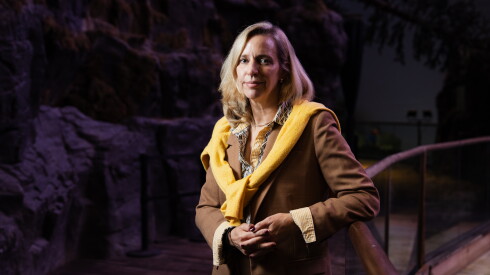
Bridget Coughlin, Shedd Aquarium’s CEO, defends the aquarium’s rescue of the Marineland belugas. “It is a travesty in the age we live in that animals and nature are being politicized …,” she says. “So I don’t want an animal welfare decision, like breeding, to be used as a device for politicization.”
Pat Nabong/Sun-Times
And in a followup email in response to Tullio’s concerns, Shedd spokesman Johnny Ford noted that the Chicago institution spent seven months before the rescue in close collaboration with Marineland veterinarians and animal care staff. Ford said that that collaboration continued after the whales arrived at Shedd.
“When we needed to share news of the losses, we first contacted Marineland’s supervisors,” Ford said. “We knew this would be painful news for the people who had cared for these whales, and we wanted to give their former staff the time and consideration they deserved. We expected the supervisors to connect with those team members directly and share the news.”
Some animal rights activists say the beluga deaths point to a bigger issue: the need to put an end to breeding whales in captivity and, by doing so, slowly phase out whales housed in tanks.
“Personally, I want to focus on these six animals swimming behind us and doing right by them. … ,” Coughlin said. “Animal welfare is a science-based question. So I can’t predict the science in the future for what is best for these animals. What I want to do right now is to make sure we get Sierra her eyedrops, Secord eating a more robust diet. Let’s take care of these animals now and evaluate the science ongoing for the future.”
Some say animal welfare is as much an ethical issue, as a scientific one.
“It is a travesty in the age we live in that animals and nature are being politicized …,” Coughlin responded. “So I don’t want an animal welfare decision, like breeding, to be used as a device for politicization.”
Shedd is in the midst of a major $300 million renovation, expected to be completed in 2028. Asked if any financial donors or potential donors have expressed hesitancy in light of the recent whale deaths, Coughlin said: “The concern we’ve heard is: ‘How are the staff doing? How are the six whales under your care doing?’”
The Sun-Times reached out to Abbott Laboratories, the company with its name on Shedd’s 3-million-gallon Oceanarium. An Abbott spokeswoman declined to comment.
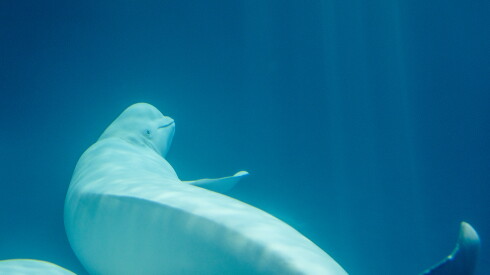
The six surviving rescues — Acadia, Gimli, Lillooet, Secord, Sierra and Yukon — are all making progress, including consistently eating a full daily diet, Shedd staff say.
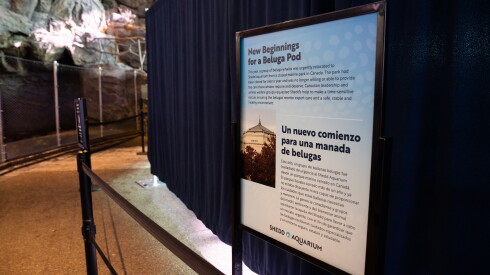
For the time being, the Marineland whales remain mostly separate from the resident Shedd belugas. There is currently no timeframe for when the public might get to see the new belugas.
“It’s all depending on the animals. We are going on the animals’ pace right now,” said Charlie Jacobsma, Shedd’s director of animal behavior and training. “We are seeing some extremely promising and exciting signs.”