It’s a wrap on Riot Fest 2026. But one big reminder of the weekend still lingers in Douglass Park — all the mud after heavy rains over the weekend turned the grounds into a shell of itself by the end of the final set.
One Little Village community group, Únete La Villita, posted on Instagram Monday that the park is “completely destroyed,” adding concerns about the “long-term effects of the fest that’s ‘just three days’” and adding they will be documenting the restoration over the next year.
Riot Fest Founder Mike Petryshyn said in a statement Monday afternoon that his team’s “responsibility does not end when the festival does. We are committed to restoring the park, working alongside the Park District and the community, and seeing that work through.” In addition to tackling the immediate repairs, that also includes working with the 24th Ward and the Chicago Park District to work on “other underlying conditions within Douglass Park” such as drainage and plumbing for “longer-term improvements,” according to Riot Fest’s statement.

Over the weekend, the aftermath of ongoing rain and heavy foot traffic from an estimated 50,000 daily attendees made it difficult to get around the park by Sunday evening when the most anticipated acts like Alanis Morissette and William Shatner took to the stage. As fans were leaving for the final time, some lost their shoes to the sludge, while others got stuck in it and were helped by strangers in a communal effort to work through it.
After getting through the weekend, a large part of the focus now is on what repairs will look like for Douglass Park in the days to come.
Beyond the actual three days the event is held in the park, Riot Fest organizers are given time to build and break down the site. On the Riot Fest website, the 2026 timeline lists Sept. 21-24 as the designated production load-out, cleaning and restoration window while Sept. 25 was listed as the date the park would be fully open to the public, though completion of load-out has since been pushed to Sept. 29, “weather and ground conditions permitting,” according to the festival. “Immediately following load-out, Riot Fest, its restoration team, and the Chicago Park District will assess the affected areas and begin implementing the restoration plan,” organizers said in a statement.
As of press time, the office of Ald. Monique Scott (24th) did not respond to comment about the projected timeline, what repairs will include and an estimate of the total cost.

Fans had mixed feelings about the mess. “As long as you’re counting one foot in front of the other, you’ll be OK. … It’s punk rock, it’s Riot Fest. Everyone is having a good time,” said Alex Ramos of Rogers Park, a repeat attendee who came out Sunday for Pierce the Veil and Pennywise. “We’ve still been seeing everybody but just battling the elements, as you can imagine.”
Joe Theis, 52, who traveled from Denver, agreed that attendees seemed to be taking the mud in stride. “I never made it to Woodstock ‘99 with the mud people and everything, but this is as close as I’ve ever been,” he said. “Everybody seems to be managing it OK.”
Grace Elliott, 35, of Cleveland, Ohio, uses a walker and described difficulties navigating the park as conditions worsened. “The wheels of my rollator were getting gummed up with mud and grass, and even going over the wood chips, it was more like dragging my mobility aid through and … my feet were stuck in the ground.”
Elliott visited an onsite accessibility tent and called the crew there “very empathetic,” though she felt out of options and eventually decided to leave.
“They didn’t straight up tell us you have to go home, but there weren’t really options for many people, especially people like me who use a mobility aid,” she added, suggesting future accommodations like more metal ramps and pathways and utilizing golf carts or ATVs to help those with limited mobility get around the park during inclement weather.
Riot Fest’s current three-year contract in Douglass Park runs through 2027. Lauren Quinn, the Chicago Park District’s deputy director of revenue, said the department will generate roughly $3 million to $4.5 million from the deal via annual permit fees.
In 2026, the deal requires Riot Fest organizers to pay $5.375 per ticket. For 2027, it increases to $5.50 per ticket, estimated at 150,000 tickets sold for all three days.
From the money raised, the park district has a 30% “give back” policy in place specifically for Douglass Park, meaning $900,000 to $1.2 million is allocated solely for improvements to the North Lawndale grounds. The contract also stipulates that Riot Fest will give an additional 10% give back “to capital improvements in Douglass Park.”
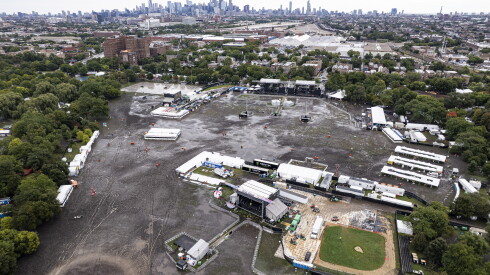
According to the Park District’s website, their staff typically does a pre- and post-event walkthrough with event organizers to identify any areas that need restoration after the event. The event permittee will also have to pay any costs to restore “identified damaged areas.”
Event organizers stated that “immediately following load-out, Riot Fest, its restoration team, and the Chicago Park District will assess the affected areas and begin implementing the restoration plan.” They have noted that the repairs are “expected to include soil preparation, aeration, seeding, grading, and sod replacement where appropriate” and may require nearly three acres of sod.
It’s similar to Lollapalooza negotiations between the Chicago Park District and organizer C3 Presents who also pay annually to re-beautify Grant Park. Though official numbers have not been released for 2026 repairs yet (after a similarly soggy event), C3 Presents paid the department $1 million in 2025.
Alyssa Espinosa, a lifelong Chicago resident and current Lawndale resident, said the city could also step up and connect community organizations that already do their own part in the Riot Fest cleanup with others to try to aid existing efforts.
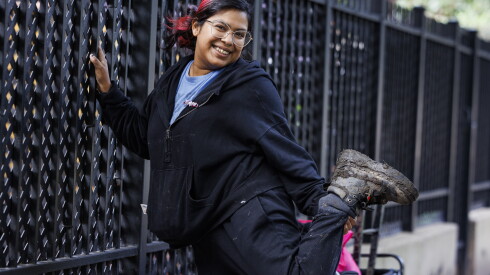
Alyssa Espinosa, a North Lawndale resident, shows off her boot outside Douglass Park on Monday, the day after Riot Fest wrapped up. “It would be great to connect those organizations to others and create this huge initiative of caring and supporting our community after and not just because they’re making a mud ocean,” Espinosa said.
Anthony Vazquez/Sun-Times
It could also be a way to help introduce more residents from other parts of the city to North Lawndale and encourage them to visit outside the festival weekend, she said.
“It would be great to connect those organizations to others and create this huge initiative of caring and supporting our community after and not just because they’re making a mud ocean,” Espinosa said. “Because nobody’s working together, they’re all fighting this uphill battle separately when they could just work together.”
It wasn’t just Riot Fest that was hit hard by weather — as festival news aggregate siteThe Festive Owl reported, other large-scale events across the country including Atlanta’s Shaky Knees and Ohio’s Lost Lands among others had evacuations or shortened hours as well due to weather.