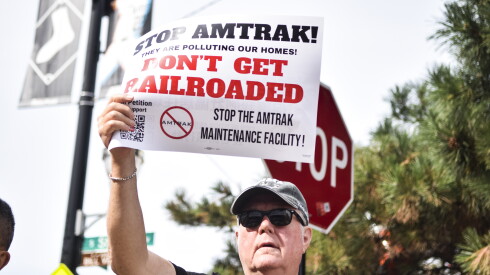
More than a hundred people gathered outside the White Sox’s Rate Field Tuesday to decry a plan that would move the team from Bridgeport to the South Loop, and in turn put an Amtrak maintenance facility in their neighborhood.
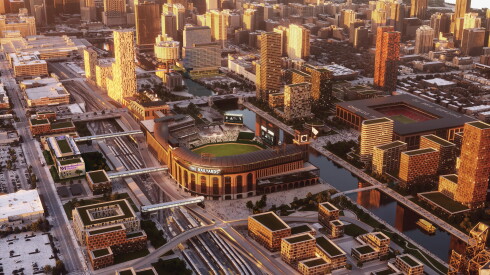
White Sox minority owner Justin Ishbia’s company, Canal Edge LLC, has proposed a mixed-use development called The Railyards as the site for a new stadium, which would be built where an Amtrak railyard now operates — and across the Chicago River from the Chicago Fire’s stadium at the 78.
The ballpark itself would be privately financed, a source with direct knowledge of the planning told the Sun-Times. But there would be an ask for public funding for local infrastructure, including for nearby roads, bridges and potentially a new Metra station, although those details are far from finalized.
Ald. Nicole Lee (11th), whose ward includes Bridgeport, said 35-year-old Rate Field has “life left” in it — though the area around it needs sprucing up. Lee’s office said Ishbia hasn’t reached out to her office to discuss how his plan would affect local residents.
“Taken together, this plan would be devastating for our community,” said Lee, who live just hundreds of feet from the proposed site of the new Amtrak facility. “We know we have to modernize the stadium, and modernize and develop these areas along 35th Street. We stand ready to have those conversations. … No 24-hour maintenance facility belongs in a residential area.”
Amtrak has said more than $600 million in federal funds is earmarked for building a new maintenance facility at the current site of a Union Pacific railyard in Bridgeport, near Rate Field. That project is also being partly financed by Ishbia’s company.
Amtrak received a federal “categorical exclusion” for the project, which is expected to start this fall. That allows it to move forward without a full environmental assessment or an environmental impact statement “unless there are extraordinary circumstances.”
In recent months, a coalition has formed around addressing the environmental and economic impact a Sox stadium move and expanded Amtrak presence would have on the neighborhood.
So far, Amtrak’s attempts at dialogue with residents has been limited to setting up two community meetings, Lee’s staff added, one of which was postponed after the alderperson’s office told Amtrak to come to the next one more prepared to answer residents’ concerns.
U.S. Rep. Mike Quigley, a North Side Democrat who is running for mayor, serves on the House appropriations committee and the subcommittee on transportation. He conceded Amtrak needed a new maintenance facility but opposed Canal Edge’s proposal — and threatened federal funding for the company.
“If they ever want help from me, or the appropriators of the delegation again, they won’t stand against you all,” Quigley said. “They need to know they can’t use preemptive powers to force this over a community’s will.”
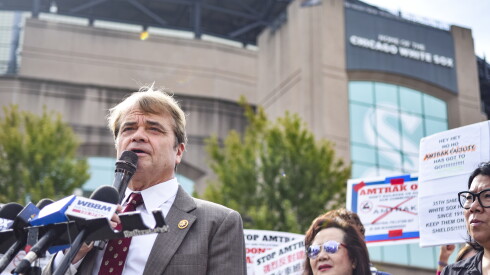
Bridgeport residents at the news conference got support from a broad array of elected officials including U.S. Rep. Danny Davis and mayoral hopefuls state comptroller Susana Mendoza and Cook County Treasurer Maria Pappas.
State Rep. Theresa Mah said she and her allies in Springfield would “use whatever means are at our disposal to block these plans.”
At a separate appearance Tuesday, Gov. JB Pritzker said he had not been briefed on the proposal, but recognized concerns from residents and urged Ishbia and the team to listen.
“[The White Sox should be] making sure they’re taking those into consideration, whatever the site may be,” Pritzker said.
Sarah Tang, a former Chinatown resident and a Bridgeport resident for the last three years, said she has heard stories from Chinatown residents on how the railyards affected the area when they were active years ago, and worried the Sox moving would mean economic devastation for the area.
“It’s a huge existential threat to the area,” said Tang, a member of the Coalition for a Better Chinese American Community. “When the railyard was active, people in Chinatown would talk about the noise pollution and vibrations. So people understand the risk — so to see the pollution potentially come back to the community in 2026 is very concerning.”
Amy Sitner, a 20-year resident of Bridgeport who lives next to her sister along the existing tracks in the neighborhood, said their yards are already truncated by a wall aimed at deflecting sound from the trains, though the noise still keeps them up at night. They fear more traffic if the facility is built.
“Even if they did an environmental study, just going in the backyard would be constant noise, you couldn’t leave windows open or open a door,” Sitner said. “I’m in danger of losing my house, or at least the value. … I feel like I’m being blindsided by this project. Everything I’ve worked for my whole life is being ripped from underneath me.”
Contributing: Tina Sfondeles, WBEZ Springfield reporter Isabela Nieto