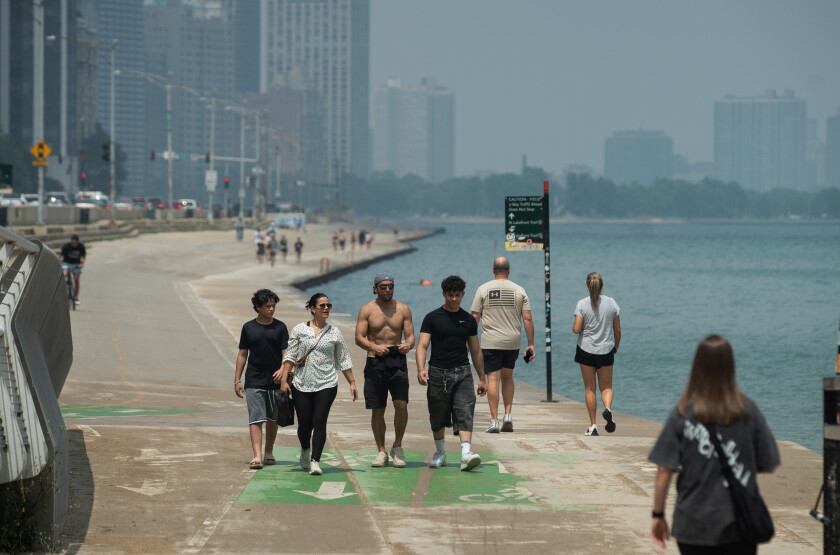
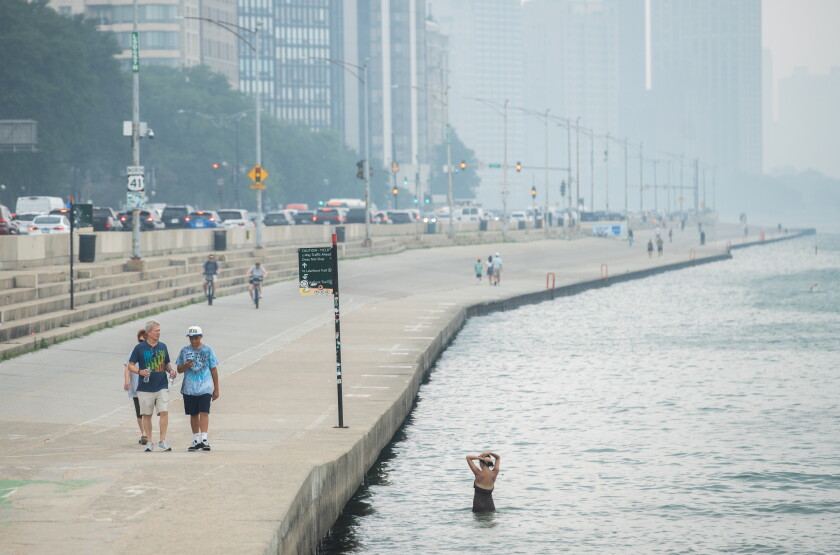
Thick, acrid smoke still blanketed the Chicago area Friday, prompting closings and cancellations in the city and suburbs.
An air quality alert is in effect through Saturday night, though the concentration of pollution in the air had begun to decrease by Friday afternoon.
Chicago’s Air Quality Index hovered around “unhealthy” by 2 p.m. Friday — down from “hazardous,” the most severe level for airborne pollutants, but still dangerous for sensitive groups.
“It looks like air quality should gradually improve as that smoke pushes off to the northeast,” said Zachary Yack, a meteorologist with the National Weather Service. “The only caveat is it’s a little unclear how fast things actually improve.”
After staying closed through the morning, Chicago beaches and outdoor pools began to reopen by mid afternoon, the Chicago Park District said.
The Osaka Garden, the Garfield Park Conservatory and the Lincoln Park Conservatory also are closed for the day, while all outdoor park district programs were moved indoors. The Chicago Architecture Center was among other attractions also closed for the day.

|
Ashlee Rezin/Sun-Times

|
Pat Nabong/Sun-Times

|
Ashlee Rezin/Sun-Times

|
Pat Nabong/Sun-Times

|
Pat Nabong/Pat Nabong/Sun-Times

|
Ashlee Rezin/Sun-Times
|
Pat Nabong/Sun-Times

|
Ashlee Rezin/Sun-Times

|
Pat Nabong/Sun-Times

|
Pat Nabong/Sun-Times
|
Pat Nabong/Sun-Times






Beaches in Evanston were closed for the day, and all non-urgent, non-public-safety-related outdoor work activities were paused, including recycling collections in the north suburb. Evanston summer camps were moved indoors, and all camps that couldn’t be relocated were canceled. The Morton Arboretum in Lisle also was closed to the public.
Organizers for some events in the area waited to make final decisions about whether to cancel. The Ravinia Festival in Highland Park, which launched its outdoor concert series last weekend with a $70 million renovation, opted to proceed with Friday night’s scheduled 8 p.m. Paul Simon performance after “closely monitoring air quality” ahead of the show.
Ravinia closed Friday’s Steans Institute Chamber Music concert, but made the show available to stream on Ravinia’s YouTube channel.
Yack said that, as winds begin to push the smoke out of the area, it still could linger near Lake Michigan before fully heading northeast.
The Illinois Environmental Protection Agency projects that air quality Saturday will be moderate — the second-least severe reading on the Air Quality Index scale.
While there is a chance smoke could return Saturday afternoon, Yack said conditions won’t be as severe.
“It probably wouldn’t be as intense as this last bout has been,” Yack said.
Health impacts may ‘catch up with people’
Some health systems in the Chicago area have begun to see an increase in admissions connected to respiratory complaints.
Endeavor Health’s Swedish Hospital saw an increase in patients with asthma and breathing issues Thursday, a representative for the health system said. No uptick in respiratory-related cases was reported at Endeavor Health’s other hospitals.
Rush pulmonologist Dr. Jack Zhao told the Sun-Times he saw “a couple” of hospital admissions Thursday involving asthma, COPD and other pulmonary exacerbations.
Northwestern Medicine Immediate Care physicians have started to see more patients seeking care for coughing, eye irritation and asthma flare-ups amid the smoky conditions, though the health system has not quantified an increase in visits, said Dr. Sindhu Aderson, regional medical director for Northwestern Medicine Immediate Care’s Central Region.
“We’ve just anecdotally seen people with more respiratory complaints, which is unusual in the summertime,” Aderson said.
Aderson cautioned that health impacts may not be immediate. “I anticipate in the coming days it’s going to catch up with people, and that’s where we’re going to see these cases come in,” she said.
Aderson urged people with asthma, COPD, heart disease and other chronic illnesses, as well as pregnant people, young children and older adults, to limit time outdoors while the smoke lingers.
“If you’re having symptoms, we want you to come in sooner than later,” she said. “We really want you to hydrate and reduce any exertion outside.”
Contributing: Cassie Walker Burke