An endangered Englewood mansion built by the Victorian era man-about-town and gambler James “Big Jim” O’Leary — his mother and her cow were blamed for starting the Great Chicago Fire — should be granted preliminary landmark status, the city’s two leading preservation groups said Monday.
Landmarks Illinois and Preservation Chicago told the Commission on Chicago Landmarks’ Program Committee that the designation is needed to protect the vacant 125-year-old O’Leary Mansion, 726 W. Garfield Blvd., from demolition.
The 33-room house is currently in Cook County Circuit Court under a raft of code violations. Inspectors reported the home’s condition as “dangerous.”
“We’re looking at a number of factors [as reasons to landmark the house], from the architecture to the architect, to the people connected with this place,” Landmarks Illinois Interim President and CEO Frank Butterfield said before the meeting.
Built in 1901, according to building permits Butterfield unearthed, the three-story mansion was designed by Zachary Taylor Davis, an architect whose works include Wrigley Field and the old — and dearly missed — Comiskey Park.
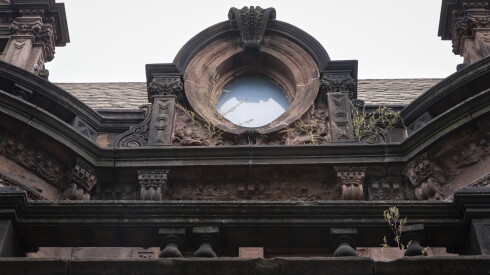
The red sandstone-fronted house is a Renaissance Revival riot design, with details that include turrets, an ornate circular attic window and two-story bay windows flanking a prominent four-columned front porch.
O’Leary’s initials can be found in the facade’s terra cotta detail.
The home is one of many surviving examples of the high-style homes and apartment buildings that were constructed along Garfield Boulevard from Wells Street to Western Avenue for the well-to-do between the late 19th and early 20th centuries.
Among the boulevard’s plump-pocketed set was James O’Leary, one of Patrick and Catherine O’Leary’s five children.
Catherine O’Leary became part of Chicago folklore when she was accused of starting the Great Chicago Fire of 1871. According to the since-debunked story, she was milking a cow in the family’s DeKoven Street barn when the animal kicked over a lantern and touched off the historic conflagration.
James O’Leary, who was two years old at the time, grew up to become wealthy. He owned a gambling house and saloon at 41st and Halsted streets that — as fate would have it — burned down in the massive Union Stock Yards fire of 1910.
“He was a gambling boss in the Union Stock Yards neighborhood and was said to be willing to gamble on anything from sports to elections to even the weather,” Butterfield said.
“So he made quite a living for himself, and as such, was able to commission quite a prominent building,” he said of O’Leary’s Garfield Boulevard manse.
O’Leary died in the house in 1925 at age 56. His mother died in 1895.
Landmarks Illinois and Preservation Chicago decided to speak up for the house because both organizations “have heard from constituents in the neighborhood, from local residents, and this is a priority for both of our organizations,” Butterfield said.
“So, when we have opportunities to work together, we are more powerful with a joint mission than we would be for one individually,” he said.
The home’s owner was absent from the committee meeting. And who owns the 6,200-square-foot house is murky. It was last listed for sale in 2024 at $450,000, listing details on Redfin show.
“We hope to have a good steward come forward to adopt the building and restore it and consent to landmark designation,” Preservation Chicago Executive Director Ward Miller said.
The Program Committee forwarded the O’Leary mansion and other landmark recommendations from the public to the Department of Planning and Development’s Historic Preservation Division for possible follow-up.
The division could take a pass on the recommendation, or after researching the building, the staffers could prepare a report that asks the full landmarks commission to grant the house a preliminary designation.
The latter is the better move and would protect the historic and architecturally significant building from demolition and wonky, non-historic alterations.
“It’s really important that we protect this building,” Miller said. “And we will be not only supporting it before the program committee … but also in court in the coming weeks.”