By Vlad Savov, Bloomberg
Nearly seven years in, the foldable smartphone era has been a letdown — but you can’t say that hardware makers haven’t tried.
Samsung Electronics Co. became the first major player in 2019 to get in on the trend, and has kept at it since, releasing four new folding phones in 2025 alone, most recently the Galaxy Z TriFold. That device, which is available in South Korea to start and coming soon to the US, has two screens, two folds and a price of roughly $2,500 — about what it would cost to buy two high-end smartphones.
Trifolds are an emerging subcategory of foldables, first attempted by Huawei Technologies Co. last year, that can take the form of both a smartphone and a widescreen tablet that’s well suited for watching videos. The convenience of having both in one gadget is supposed to overshadow the fact you could purchase both an iPhone Pro Max and iPad Pro for less.
But after a week of testing one of the first Galaxy Z TriFold units available in Seoul, it’s clear that this experimental phone is also held back by some unique design flaws that make it even less polished than regular — dare I say, normal — foldables. The price alone, and the engineering complexity that necessitates it, cements the device’s status as a niche item, all but ensuring it won’t resonate beyond early adopters and tech enthusiasts.
Samsung’s latest launch is especially daring considering how little sales success it’s had in this segment. The category, which also includes models from heavyweights like Google and Huawei, still accounts for less than 2% of global phone sales, according to IDC data. Apple Inc. has so far sat out the fad, though it’s expected to release a folding iPhone in 2026. That makes the new year a pivotal time for the entire sector.
Tradeoffs Everywhere

Samsung designed the TriFold to be folded up like a wallet, with creases splitting it into three sections when you’re holding the device in tablet mode. If the user begins to fold it incorrectly — by closing the right side before the left, for instance — the phone quickly warns them with on-screen notifications and physical vibrations. (Over a week of showing the handset to friends and colleagues, I found that most people do, in fact, initially get it wrong.)
But there’s no denying it’s sturdy. Samsung’s years of foldable engineering work show up in the TriFold’s construction. The device, which is the size of a 6.5-inch phone when shut, has zero gaps between its three sections and feels reassuringly dense and rigid in the hand. The hinges similarly exhibit the right amount of resistance and snap when opening and closing, and Samsung has slimmed every panel down to effectively the height of the necessary USB-C port.
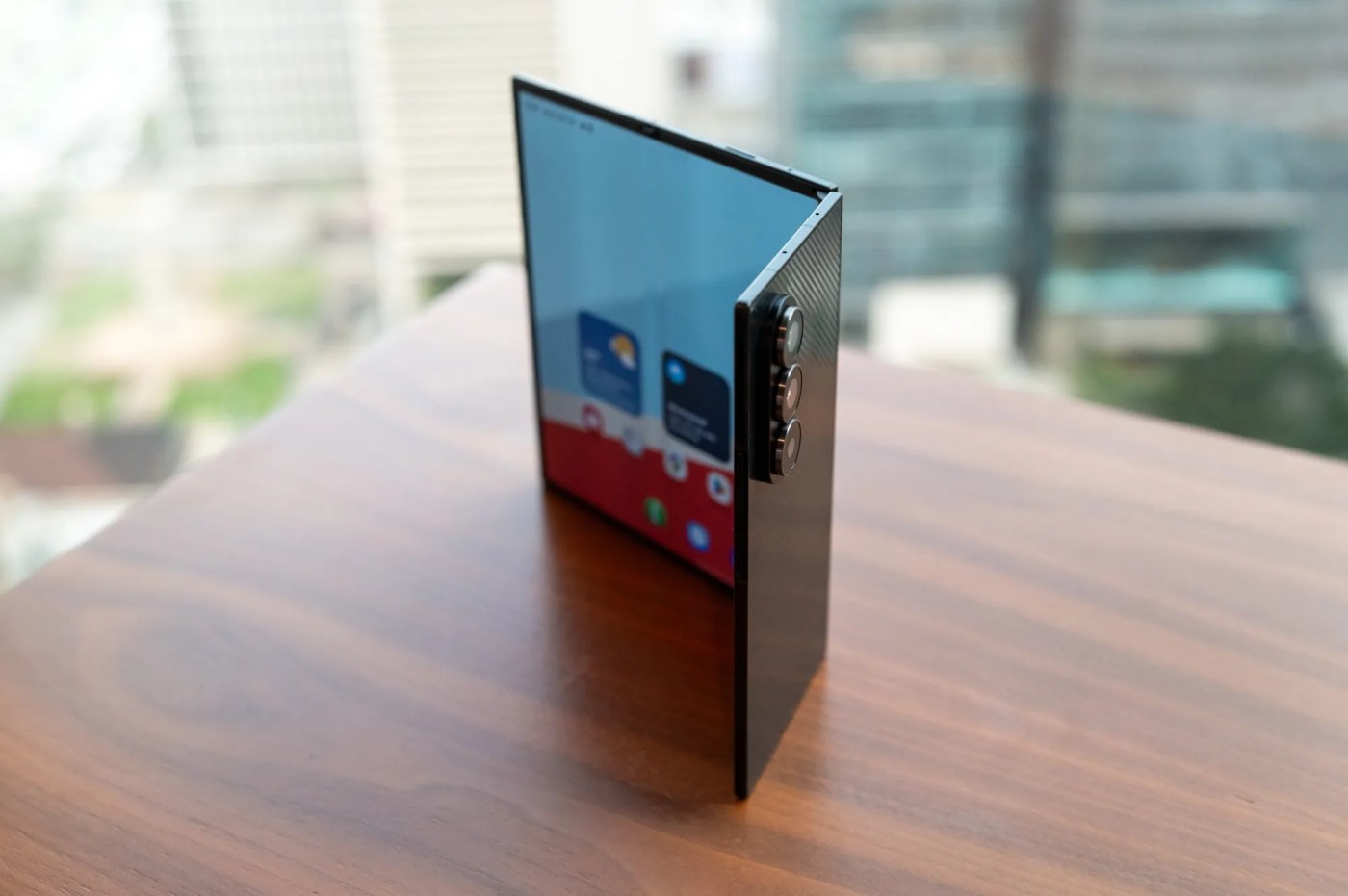
While the phone is slimmer in most spots than the iPhone Air and many iPads, Samsung achieved that feat by pushing all the camera hardware into a large and heavy additional module. The TriFold’s back has both a camera bump and three lenses that protrude further out, undermining the broader emphasis on thinness.
The result is that the device feels lopsided both in the hand and when you place it on a flat surface. The fundamental premise of a foldable tablet like the TriFold is that the user gets the largest possible screen to use on the move in a pocketable form factor. But the experience is compromised when the weight is as imbalanced as it is here. The poor ergonomics made me not want to hold up the device to watch much video, even though the aspect ratio on the inner display is actually well suited for it. And it’s not as if there’s a built-in kickstand to give the user a break.
The 10-inch interior screen is also more prone to glare and reflections than other smartphone displays. Oppo’s Find N5 foldable from earlier this year is vastly superior in this respect, proof that it’s possible to do better even with a flexible panel.
Making matters worse is some poor camera performance. Low-light photos appear grainy and dull, lacking the sharpness achieved by even midrange Android smartphones such as the $630 Xiaomi 17 or $799 Google Pixel 10. Samsung threw in additional selfie cameras on the big inner screen — which makes sense for video calls — as well as on the exterior. The latter is superfluous since the handset can already use the main camera in concert with the outside screen.
Another issue stems from the semi-circular bumps at the top and bottom of each hinge, which interfere with multitasking gestures when you’re using the screen in landscape mode. They also make swiping to the side in portrait mode awkward.
Samsung also hasn’t solved a problem that’s endemic to foldables: the visible crease that occurs where the screen bends. Because the TriFold folds in two places, it has two such creases, and they remain apparent. While they’re more subtle from certain angles when the screen is on, you’ll always feel the creases as you’re swiping around. For all the improvements that Samsung and rivals like Huawei have made, this lingering design flaw presents a challenge to selling such devices at sky-high prices: That segment of the consumer market rarely accepts compromises.
But tradeoffs and imperfections define the experience of using the Galaxy Z TriFold. Samsung swaps the typical fingerprint sensor embedded in the display for one built into the power button on the side. It’s slower, less precise and less comfortable to use than what the vast majority of Android phones offer, including Samsung’s more conventional handsets. The folding design also precluded Samsung from putting the speakers on the sides, which means they offer less stereo separation than you’d get on a dedicated tablet.
The TriFold’s advantages over a regular handset — the large 10-inch display and good-for-a-smartphone audio quality — would be better served by an outsized battery to power them. Instead, the rather modest 5,600 milliampere-hour battery can trigger the smartphone equivalent of range anxiety, forcing users to choose between using the device as intended or conserving power. Gaming and video playback are particularly draining: Any extensive sessions are often cut short by battery depletion warnings that more conventional smartphones wouldn’t succumb to until hours later.
In comparison, recent Chinese flagships like Xiaomi Corp.’s 17 Pro Max and Oppo’s Find X9 Pro both offer bigger 7,500mAh batteries, offering consumers a reason to consider sticking with conventional non-folding phones.
Recharging speeds are also slower compared with the Chinese competition. Samsung has equipped the TriFold with 45-watt wired and 15-watt wireless charging, while Vivo’s non-folding X300 Pro, for example, reaches 90 watts wired and 40 watts wirelessly, and has a larger battery to boot.
With this phone, Samsung made an attempt to optimize the software to take advantage of the larger screen. Using the company’s DeX software, which has been tweaked for this particular hardware type, you can also run a desktop-like experience directly on the large inner display. (Other Samsung phones must be plugged into an external monitor to activate DeX mode.) In DeX, the TriFold can operate as many as four distinct workspaces that can each run five apps simultaneously.
Beyond that, the software experience feels half-baked, and not fully tailored for this new hardware type. Popular apps like Instagram are not all optimized, with Instagram Reels displaying in only one half of the screen when viewed in landscape. Meanwhile, the ability to run apps side by side has been standard on foldable devices for years, and is still of limited utility, so Samsung only deserves modest credit for implementing it here.
Samsung has added the ability to start an activity on the exterior display and continue it on the inside by opening the TriFold to reveal the larger screen. However, that trick doesn’t work in reverse. For example, after picking a destination on Google Maps with the device open, the user can’t simply close the device and still see the route on the smaller screen.
The foldable proposition has always been reminiscent of the one that Apple offered with the original iPhone: pay an exceptionally high price and accept worse durability and battery life for the privilege of a futuristic design with a much larger screen. The problem for foldables is that standalone tablets already offer bigger displays at a much lower cost with very few design tradeoffs.
Samsung’s pricey Galaxy Z TriFold doesn’t advance the foldable category in a meaningful way, serving mainly to underscore how great the engineering and design challenges are. Even more basic foldables, such as the Galaxy Z Fold 7, have only just begun to offer user experiences that come close to matching conventional smartphones.
Adding an extra crease to a device for the sake of innovating and maximizing screen real estate means those devices will, for now, be more expensive and less refined. The adventurous shoppers keen to try out a first-generation foldable device will be better served waiting to see what Apple has to offer when it makes its long-awaited debut in this space.
More stories like this are available on bloomberg.com
©2025 Bloomberg L.P.