For the past 12 months, fire survivors have been imagining their rebuilt futures.
They can’t get back their homes lost in the Eaton and Palisades fires, but a growing number of grassroots real estate ventures have emerged in the aftermath of those January firestorms to help them envision what could lie ahead.
A year into the recovery, such ventures provide a glimpse at what neighborhood homes and structures might look like in towns where the architecture and scale of dwellings themselves were very much part of the local vibe and character.
- Also see: A builder channels his Eaton fire ‘trauma response’ with hopes of easing the stress of rebuilding
- Also see: LA wildfire victims building ADUs as first step in home rebuilding process
You can see that vision emerging in an array of architectual renderings, floorplans and early building in the fire zones.
These options include relocating historic homes saved from demolition, craning in factory-built homes and shopping for pre-approved plans from catalogs.
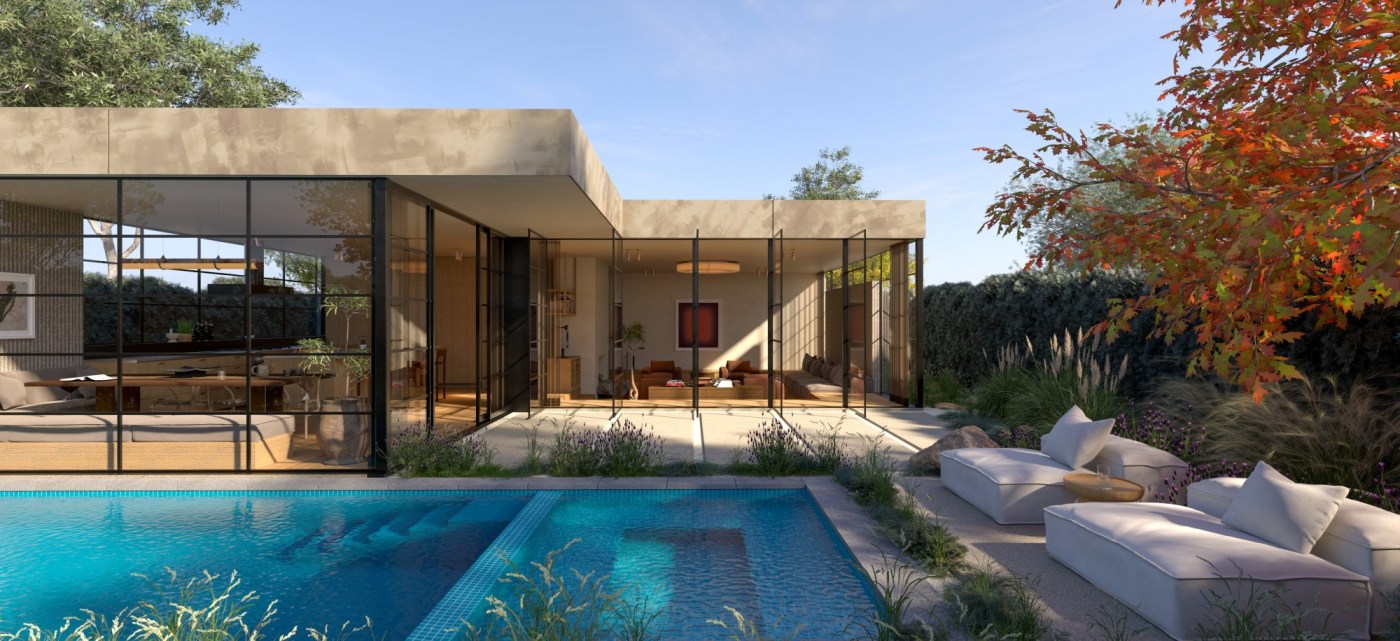
And the look of things varies, from designs that harken back to the age of Craftsman and Spanish-Colonial styles, to more minimalist, modern takes on a home’s design.
Technology is also playing a role.
Can’t decide on a home to fit your lot? AI can narrow down the choices by address.
The common thread here is to cut the red tape, making the process of rebuilding fast and affordable so people can get back home. Because the need for organized efforts in rebuilding homes after a significant disaster is so large, local builders alone won’t be able to meet the demand.

Historic House Relocation Project
Morgan Sykes Jaybush, the creative director of the Los Angeles architecture firm Omgivning, launched a project to relocate homes slated for demolition in greater Los Angeles to Altadena.
As the project manager for these house relocations, Jaybush highlighted the historical precedent for moving homes in Los Angeles. He cited past relocations from Bunker Hill to Highland Park and from Hollywood to Los Feliz. He argued that many homes, although not classified as historic, could serve those in need rather than face demolition.
- Also see: A West Altadena family is coming home, keeping generations of family rooted in neighborhood
“Relocating houses used to be much more common in Los Angeles, but it’s rarely done nowadays,” he said in a statement. “It’s the most sustainable way to rebuild, by not throwing an entire house into the landfill. It’s also a great way to bring some historic character back to these neighborhoods which have suffered so much loss. And in addition to being a quicker solution, it’s a more affordable option; we estimate that these moves are half to two thirds of the cost of a new build.”

In early August, Gwen Sukeena and Jacques Laramee watched as 18-wheelers delivered a 1910 Craftsman-style house, moving it from Los Feliz to their cleared Altadena lot in four sections.
The 3,600-square-foot house, with five bedrooms and wainscoting, has the distinction of having been relocated in 1948 to make way for the construction of the 101 Freeway. According to Life magazine, the owner at that time hosted a party for 150 people inside the house while it was being moved across the city.
As Laramee told the Southern California News Group in August, “The history of the home captivated us. We had to save this house.”

Steadfast LA Foundation Modular Housing Initiative
This non-profit organization created by businessman Rick Caruso partnered with prefab company Samara, co-founded by Airbnb’s Joe Gebbia, to provide modular housing for low-income residents displaced by the Eaton and Palisades fires. Gebbia committed $15 million to supply about 50 free, factory-built homes.
Samara has taken charge of building, installing and permitting homes, which vary in size from 420-square-foot studios to 950-square-foot, two-bedroom units. The largest home, as previously reported by Southern California News Group, runs about $261,000, which can double once installation, permitting and other setup costs get factored.
- Also see: In Pasadena’s Hastings Ranch, rebuilt primary house is first in Eaton fire zone to get OK to live in
- Also see: What’s a ‘pre-fab’ house, and could they work in Altadena? This open house aims to educate
“This initiative is about keeping communities intact,” Caruso said in a statement, emphasizing many affected people have lived in these neighborhoods for decades, only to face the loss of their homes due to underinsurance or a complete lack of insurance.
The on-site installation takes a few weeks.

Case Study 2.0
The Case Study House Program featured in Arts and Architecture magazine from 1945 to 1966, inspired real estate consultants Steven and Jason Somers to create Case Study 2.0.
Their catalog of over 50 architect-designed plans range stylistically from revivals to modern glass boxes. Standard plans are $25 per square foot, excluding engineer fees. Modifications require a separate agreement with the architect, possibly requiring extra time and money to complete the project. But all plans meet or exceed current Wildlife Urban Interface standards and local building codes for fire resistance.

Case Study 2.0 anticipates contractors will build more quickly and efficiently by using the same design details across multiple projects.
“If we can get away from completely one-off construction projects, and we can start building these things at scale, then you can build an esthetically elevated house by a world-class architect for substantially reduced construction costs,” Steven Somers, chief executive of Crest Real Estate and co-founder of Case Study 2.0 told the Southern California News Group in June.
As of mid-December, Somers said a dozen Case Study 2.0 projects were actively in the works, mostly in the Palisades area.
“I think people are still working their way through insurance and trying to determine what to do next,” he said. “But I think we’ve had a positive impact.”

Foothill Catalog Foundation
This non-profit organization, established by husband-and-wife architects Alex Athenson and Cynthia Sigler, draws inspiration from the Sears Roebuck “Modern Homes” catalog of the early 20th century.
Committed to preserving the unique character of Altadena, the Foothill Catalog Foundation simplifies the rebuilding process by providing pre-approved home designs rooted in historical styles, including Craftsman, Ranch, Spanish Revival, Tudor and Mid-Century Modern. The result is an eclectic mix of architectural options that honor the past while facilitating community development.

Recently, Foothill Catalog Foundation collaborated with San Gabriel Valley Habitat for Humanity to create plans for several rebuilds. One of those plans is “The Lewis,” which inspired the 1,160-square-foot home with three bedrooms and two bathrooms recently built for Kenneth and Carol Wood, a couple who has lived in Altadena for more than 40 years. It was the first of 25 rebuilds planned for the next 12 months.
The Altadena Builds Back Foundation, created by the Pasadena Community Foundation, is funding for 22 of the 25 rebuilds, thanks to a $4.55 million grant.

Builders Allliance
This standalone nonprofit organization provides displaced residents a comprehensive end-to-end digital solution to rebuilding in a single platform to save time and money.
Simply enter your address, and the tech-enabled portal calls up a list of pre-approved plans from its library with pricing up front, filtered by specific lot, zoning, pricing and owner’s preferences. It’s similar to searching for homes on third-party MLS sites like Zillow.
- Then and Now: An aerial comparison of Palisades fire aftermath nearly 1 year later
- Then and Now: An aerial comparison of Eaton fire aftermath nearly 1 year later
The AI-driven tools even lets you see how the homes fit on the lots.
“You literally pick your home, hire your builder and never come back to your site until the day it’s ready if that’s what you wanted,” said Bea Hsu, president and CEO of Builders Alliance.
There are 10 participating homebuilders in the alliance, ranging from small boutique firms to volume builders.
Adrian Foley, president and CEO of Brookfield Residential, emphasizes the unique approach of the Builders Alliance in offering a variety of building solutions.
“We’ve clumped together as a group with the goal of providing you with a series of options,” he said. “It is a one-stop shop, it is a clear path to a decision and removes a lot of the complexity.”
As of mid-December, Builders Alliance saw 4,043 unique visits. These visitors registered and reviewed plans and content on a specific address, and 2,178 returned to review those addresses multiple times. They actively selected floor plans and moved them around. Another 759 of these visitors turned into leads, and 110 engaged in one-on-one conversations, taking the process to the next level.