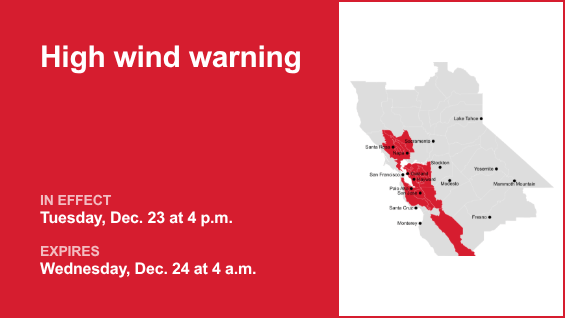
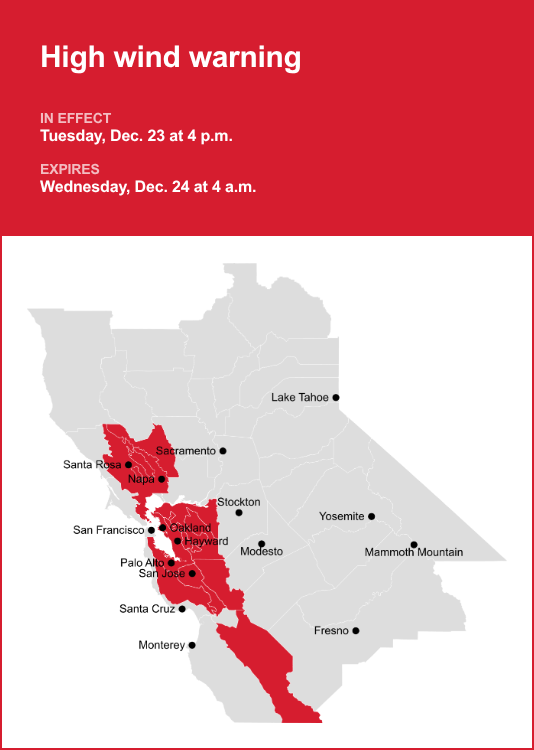
Northern California is included in a high wind warning released by the National Weather Service on Tuesday at 12:55 p.m. The warning is valid from 4 p.m. until Wednesday Dec. 24, at 4 a.m.
According to the NWS San Francisco CA, “Southeast winds 20 to 30 mph with gusts up to 65 mph expected.”
“Damaging winds could down trees, snap power lines, and result in property damage. Widespread power outages are possible. Travel could be extremely difficult and hazardous, especially for high profile vehicles,” according to the NWS. “People are urged to secure loose objects that could be blown around or damaged by the wind.”
The full list of affected locations includes:
- North Bay Interior Mountains
- North Bay Interior Valleys
- San Francisco Bay Shoreline
- East Bay Interior Valleys
- Santa Cruz Mountains
- Santa Clara Valley Including San Jose
- Eastern Santa Clara Hills
- East Bay Hills
- Mountains Of San Benito County And Interior Monterey County Including Pinnacles National Park
Emergency alerts in the San Francisco Bay Area
All enabled mobile phones in the area will receive emergency alerts for “considerable or catastrophic” hazards. To monitor other local risk, residents are advised to sign up for county alert systems and to monitor agencies’ social media. Follow these instructions to enable your phone to receive Wireless Emergency Alerts (WEAs). To receive local alerts in the Bay Area, visit each county’s website:
Understanding high wind alerts
When it comes to high wind alerts, staying informed is essential. Here’s a breakdown of the three-tiered alert system from the NWS and what each level entails:
High wind warning: Take action!
Sustained, strong winds with even stronger gusts are happening. Seek shelter. If you are driving, keep both hands on the wheel and slow down.
Wind advisory: Take action!
Strong winds are occurring but are not so strong as to warrant a High wind warning. Objects that are outdoors should be secured and caution should be taken if driving.
High wind watch: Be prepared!
Sustained, strong winds are possible. Secure loose outdoor items and adjust plans as necessary so you’re not caught outside.
How to prepare before strong winds approach
- Trim tree branches away from your house and power lines.
- Secure loose gutters and shutters.
- Identify an interior room of your house, such as a basement or interior bathroom, that you can take shelter in during high wind warnings.
- If you live in a mobile home, identify a sturdy building you can go to if the NWS issues a high wind or severe thunderstorm warning.
- Charge batteries of all essential items such as cell phones and booster packs, weather radios and power tools such as a reciprocating saw, which you might need to clear debris.
- Update your emergency kit and be sure to include enough food and water to last for 3 days for each person in your home.
- Make a list of items outside your home you will need to tie down or put away so that they don’t blow away or fly through a window. When the NWS issues a high wind watch, immediately secure these items to avoid damage or injury once the wind starts picking up.
How to act during strong winds
Take shelter:
- Immediately go inside a sturdy building during a high wind warning or severe thunderstorm warning and move to an interior room or basement.
- If you are in a mobile home, move to a sturdy building before the winds pick up or the storm system reaches your location.
If caught outside or driving:
- Take shelter in your car if you are not near a sturdy building. If possible, drive to a nearby sturdy building. Otherwise, move your car to a location where it is less likely to be hit by falling trees or power lines.
- If no shelter is available avoid trees, power lines, and the side of the road. Keep in mind that power lines that are laying on the ground may be live. Do not go near them! Try to find a place that will block blowing or falling debris.
- If you are driving and aren’t near a sturdy building, hold the steering wheel with both hands and slow down.
- Keep a distance from high profile vehicles such as trucks, buses and vehicles towing trailers. One strong gust of wind can be enough to flip one of these trailers onto its side.
What to do after strong winds subside
- Do not go near downed power lines. Report downed power lines to the police.
- Be careful when handling debris that may have blown into your yard.
For more weather alerts in the Bay Area, visit Weather Advisories