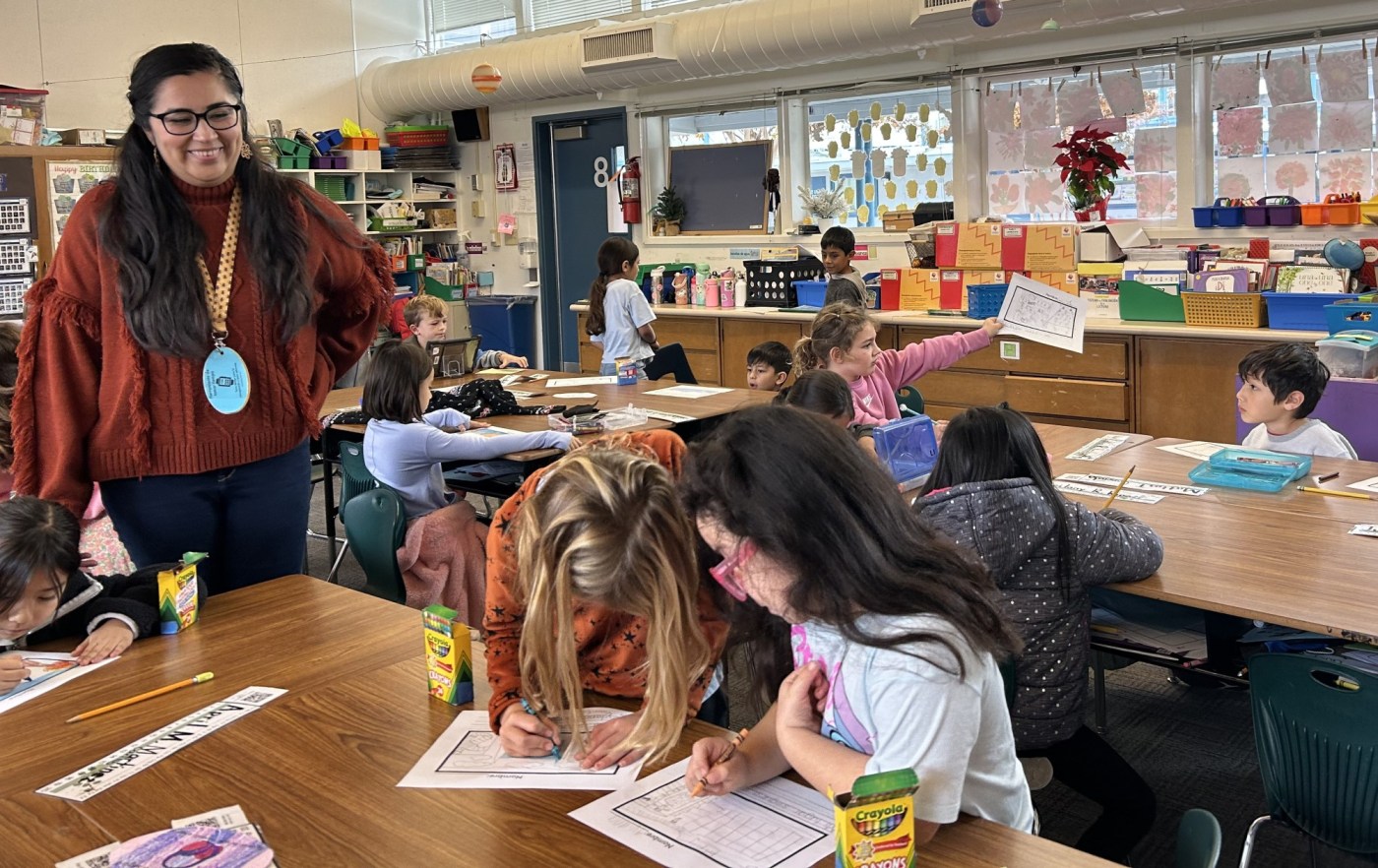
“Draw your safe place.”
On a winter morning in Mindy Banuelos’ first grade classroom, 25 students bent over their desks, pencils and crayons in constant motion. One boy sketched the tree in a park where he and his father like to sit at sunset. Another drew the lake where he loves to fish — “one time, I caught a huge fish,” he said. A third carefully outlined Disneyland, complete with rides.
Banuelos had asked her students at Napa’s Pueblo Vista Elementary to picture a quiet or safe place they could retreat to when they felt frustrated or overwhelmed. She was teaching them the “Quiet/Safe Place Tool,” one of 12 social-emotional strategies meant to help young children navigate daily challenges.
Each month came with a new tool: the breathing tool, the personal space tool, the please-and-thank-you tool. Each had a simple icon — a measuring tape, a ball of yarn, a pair of keys — and once students understood the tool, they colored the icon and tucked it into their own paper “toolboxes.”


“The toolbox helps students with their relationships with parents and teachers,” Banuelos said. “Sometimes they shut down and don’t know what to do to solve their problems, and these tools guide them. What I enjoy is hearing them come back and say they used a tool at home — like one student who said she was frustrated with her sister, so she went to her quiet place and later sorted it out when her body was more calm.”
The Toolbox Project, now used across every elementary campus in the Napa Valley Unified School District, is a social-emotional learning program aimed at strengthening children’s “inherent capacity for resilience, self-mastery and empathy for self and others.” It gives kids language to describe their feelings — and gives adults a shared way to talk about emotions with them.
Today the curriculum reaches 265,000 students in 200 cities across 11 countries. Its global arc began in a small, remote school in Northern California.

The origin story
In the 1990s, Sebastopol resident Mark Collin stumbled into the role of school counselor at a small K-8 campus in rural Cazadero. Intent on serving the community, he had left a lucrative career as a general contractor to pursue psychology and earn his marriage and family therapist license. He expected to complete the required “kid hours” in three months. He stayed eight years.
Having struggled in school himself, Collin quickly recognized that many students were carrying significant emotional burdens — and lacked the vocabulary or coping strategies to address them.
“There were kids being dumped in garbage cans by older students, kids who would hide under their desks, kids who were traumatized,” he said. “I could see something was missing in their lives and I felt called to stay with them.”
Working with kindergarteners, he developed what became the first tool: the breathing tool. He invited students — often agitated or distracted — to circle up and breathe together, one hand on their heart and the other on their stomach. Slowly, the room calmed.
As trust grew, so did the collection of tools. Students helped him identify what they needed. The “toolbox” metaphor came from Collin’s carpentry background, grounding abstract concepts in something young children could grasp.
By the program’s third year, they had 11 tools. Then a fourth grader raised her hand and suggested one more: the courage tool.
“I thought to myself: why didn’t I come up with that?” Collin said, laughing. When he asked where the idea came from, she explained that her dad and two brothers teased her when she tried to use her tools at home. “It takes a lot of courage to use your tools when others aren’t using theirs,” she told him.
With that, the toolbox was complete.
Collin said he watched the school change. Students found safety in the classroom, and he saw the community shift around them. As word spread, schools invited him to share the program. With a partner, he wrote the first formal curriculum in the early 2000s. Soon it appeared across the Bay Area, then in Canada, France, South Africa and beyond.
“There are a lot of social-emotional learning programs,” Collin said. “But this one goes deeper because it’s archetypal. And we use tools. So it grounds this work in very practical things.”
He later created a family toolbox for parents and children to use together and a corporate toolbox to help managers support their teams.
Still based in Sebastopol, the Toolbox Project provides curriculum materials, posters, flashcards, activities and teacher training. Over the years, its work has been recommended by researchers, honored by the Sonoma County Office of Education and Sonoma State University, and recognized by CASEL, the nation’s leading social-emotional learning organization.
A lasting impact
But perhaps the program’s most meaningful endorsement comes from the former Cazadero students who helped build it.
Elizabeth Moeckel is now an emergency dispatcher.
Krista Butts works in community outreach for the Santa Rosa Fire Department.
Hayden Cassidy is an assistant manager at a local Whole Foods.
All three hold high-stress jobs that require strong emotional regulation and communication. In separate interviews, each credited their early training in Collin’s classroom for those skills.
The toolbox followed them into adulthood, they said. Butts feels “so ready” to talk with her twins in transitional kindergarten about feelings because she learned early that discussing emotions is healthy.
And the group remains unusually close. They say they can still share difficult emotions and talk through hard topics with ease.
“I meet people in my adult life and they don’t know how to regulate their emotions or talk about them,” Moeckel said. “But then I run into somebody I knew when I was a child and we can just talk about all the dark and dreary things in life because we were taught it’s OK to have those feelings.”
Their experience reflects the challenges facing young children today. Studies show the pandemic disrupted early socialization. Heavy social media use is strongly tied to mental health challenges. Bullying and stress remain persistent concerns.
“We need to give these students the tools to handle these problems,” Collin said. “My hope is to pass the Toolbox Project on to this next generation.”
Back in Napa
At Pueblo Vista Elementary, the Toolbox Project has become woven into school culture.
A gratitude tree created with the please-and-thank-you tool greets families at the entrance. In the nurse’s office, a child hurt at recess might be asked to use their courage tool. And in classrooms, it’s not uncommon to hear students reminding their teachers to use their breathing tool when tensions rise.
“The beautiful part about Toolbox is it’s created a common language,” Principal Helen Rocca said. “When kids are feeling these emotions, they have the vocabulary to discuss it. It becomes a way in which they can think.”