Chicago is careening toward a pre-election budget stalemate after Mayor Brandon Johnson’s $17.6 billion spending plan landed like a thud Wednesday in a City Council dead-set against his revived corporate head tax.
Johnson’s renewed call for the failed head tax, says Civic Federation President Joe Ferguson, shows that “the work that last year’s volatile budget cycle made clear was necessary — simply has not been done one year later.
“There is likely to be a new game of chicken or brinkmanship here that takes us to the deadline,” Ferguson said, minutes before Johnson delivered the nearly 50-minute budget address to the Council.


|
Ashlee Rezin/Sun-Times

|
Ashlee Rezin/Sun-Times

|
Ashlee Rezin/Sun-Times

|
Ashlee Rezin/Sun-Times

|
Ashlee Rezin/Sun-Times

|
Ashlee Rezin/Sun-Times

|
Ashlee Rezin/Sun-Times

|
Ashlee Rezin/Sun-Times

|
Ashlee Rezin/Sun-Times

|
Ashlee Rezin/Sun-Times

|
Ashlee Rezin/Sun-Times

|
Ashlee Rezin/Sun-Times

|
Ashlee Rezin/Sun-Times

|
Ashlee Rezin/Sun-Times

|
Ashlee Rezin/Sun-Times

|
Ashlee Rezin/Sun-Times

|
Ashlee Rezin/Sun-Times

|
Ashlee Rezin/Sun-Times

|
Ashlee Rezin/Sun-Times

|
Ashlee Rezin/Sun-Times

|
Ashlee Rezin/Sun-Times

|
Ashlee Rezin/Sun-Times

|
Ashlee Rezin/Sun-Times

|
Ashlee Rezin/Sun-Times

|
Ashlee Rezin/Sun-Times

|
Ashlee Rezin/Sun-Times


Last year, Johnson’s aldermanic opposition shot down his proposed corporate head tax, and instead passed an alternate budget against his wishes. The mayor’s attempt to make the head tax easier to swallow this year by pairing it with a “full rebate” for jobs located in impoverished communities did not seem to soften his opponents.
“This is like Yogi Berra said: `Déjà vu all over again.’ We don’t know why he’s so insistent on taxing jobs,” said Derek Douglas, president of the Civic Committee of the Commercial Club, one of Chicago’s most influential business groups. “We have a growth issue. Any policies that make that worse, we’re gonna oppose and we’re gonna oppose it vigorously. Last year, he did it. It was rejected. He’s back with the same idea again. We hope the City Council will reject it again.”
Chicagoland Chamber of Commerce President Jack Lavin said the business community will join the Civic Committee in mounting a full-court press to block the head tax and Johnson’s proposed cloud tax increase he called “direct taxes on small businesses — not the tax on Big Tech” that Johnson is trying to sell.
“The cloud tax is essentially a sales tax — and I don’t think there’s anywhere in the nation where there’s a 20% sales tax,” Lavin said.
“This is on every small business in Chicago and every resident who has software or leases equipment to do work. The tax impacts businesses of all sizes. It’s about technology and leased assets that businesses of all sizes depend on to operate… for digital advertising and all things they need to do to get their product out there.”

Mike Ruemmler, president of One Future Illinois, said the non profit-created by business leaders to influence city and state policy is prepared to spend “hundreds of thousands of dollars” to educate voters and their alderpersons.
“If he would listen to his colleagues on the Council, he would know that a head tax is D.O.A., but… his goal doesn’t seem to be a budget that’s trying to build consensus. It’s a budget about trying to rev up his base to make sure he gets to the runoff,” Ruemmler said.
Zoning Committee Chair Gilbert Villegas (36th) said the proposed 33% ramp-up of the cloud tax that has turned into a cash cow for the city would fall most heavily on “folks using Microsoft 365 who are not millionaires.”
“This is a different version of nickel-and-diming everyday Chicagoans,” Villegas said.
Ald. Andre Vasquez (40th), who chairs the Hispanic Caucus and co-chairs the Progressive Caucus, countered that the cloud tax is “one of the few levers we have.” He added that it “should have been raised even higher last year” and he would support the mayor’s proposal to take it to 20%. He also supports the head tax, as he did last year.
But Vasquez said he is adamantly opposed to Johnson’s plan to borrow $480 million over two years to cover the $260.8 million global settlement to 17 plaintiffs framed for murders by corrupt former Chicago police Det. Reynaldo Guevara and other police-related settlements either “expected or approved.”
“They just tried to bond out to get… $70 million and only got $30 million to close a gap last year. So it’s clear that we’re not able to borrow even when we think can borrow. Our credit ratings keep going down, which makes our ability to borrow even harder. And borrowing to cover more than half the deficit — you’ve got to make the case for how that’s responsible, because I don’t see it,” Vasquez said.
Last year, a 31-member coalition of conservative and moderate alderpersons rejected the corporate head tax and pushed through an alternative budget that authorized video gambling terminals, selling outstanding debt and other alternative revenues that Johnson opposed and has either been unwilling or unable to implement.
Ferguson said the “single most disappointing… and almost cynical feature” of Johnson’s budget is that there is “literally nothing more than marginal savings and efficiencies.”
“What are deemed efficiencies is just cover mostly for chopping away at the police department,” Ferguson said. “It’s only taking an ax to that, and calling it savings and efficiencies.”
Johnson has used his first three budgets to shrink the Chicago Police Department by attrition. His fourth budget includes more of the same.
In a briefing with reporters Tuesday, Acting Budget Director Jonathon Ernst acknowledged that Johnson “froze 500 police officer vacancies” in his 2026 budget and that the city would be “continuing that at a lesser level” next year to cut personnel costs by $34.4 million. The mayor’s press office says the number of police vacancies that would be eliminated in the mayor’s proposed budget is 368. Another 132 sworn vacancies will become civilian positions.
The Chicago Police Department’s annual budget would rise from $2.12 billion this year to $2.24 billion in 2027 to cover police pay raises.
Johnson said there is a “freeze on the number of positions, so our budget can be balanced.” But it “doesn’t prevent the department from hiring as we have looked at what’s necessary, particularly through attrition.”
“What they’ve requested, we’ve been able to meet. That also includes the ability for promotions as well.”
Johnson also eyes the $75 million up-front payment from Stonepeak Partners tied to the New York investment firm’s $2.5 billion acquisition of Chicago parking meters as a way to defray the cost of the $364 million advance pension payment in 2027.
Former Finance Chair Scott Waguespack, one of the Council leaders who negotiated the deal, said he assumed that the $75 million would be over and above the pension advance, and that the ongoing profit sharing payments from Stonepeak would also be used exclusively to chip away at the city’s $36 billion pension crisis.
“Just like the head tax, we’ll reject that,” Waguespack said.
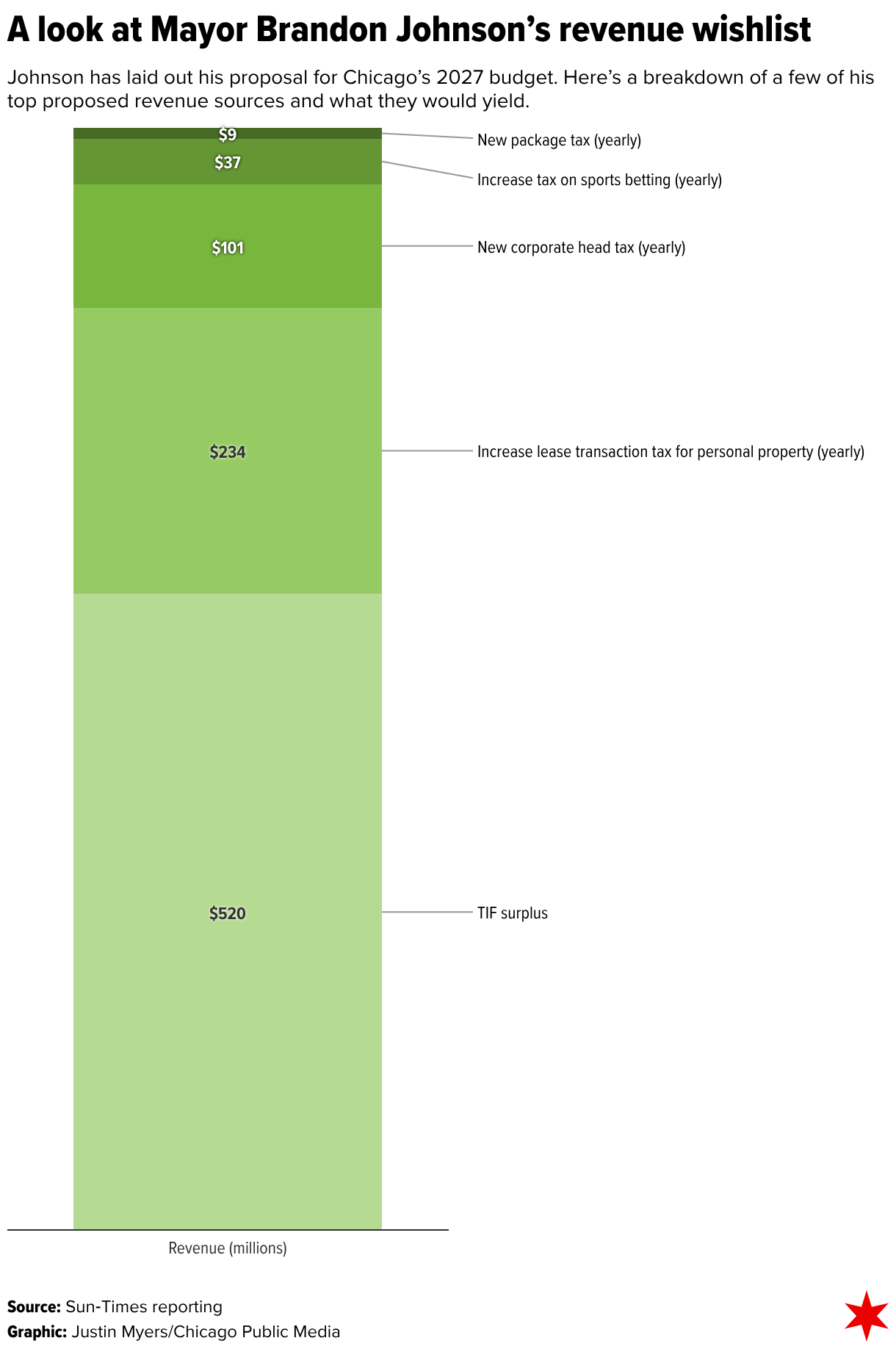
The Sports Betting Alliance, which represents DraftKings, FanDuel and other sportsbooks, is also lining up to oppose the mayor’s plan to nearly double the Chicago tax on sports betting. Johnson has argued that the $37 million in increased revenue would be “generated from the companies — not actual bettors.” But sportsbooks that have a pending lawsuit against the city said the tax burden would fall on the backs of sports fans.
“Doubling the tax rate for legal sports betting will raise the cost to play for Chicago fans and drive them out of state-licensed sportsbooks that protect consumers,” the alliance’s statement said.