
No one was taken into custody in the day since the University of Chicago announced that school officials had identified a man accused of sexual assault at an off-campus fraternity party.
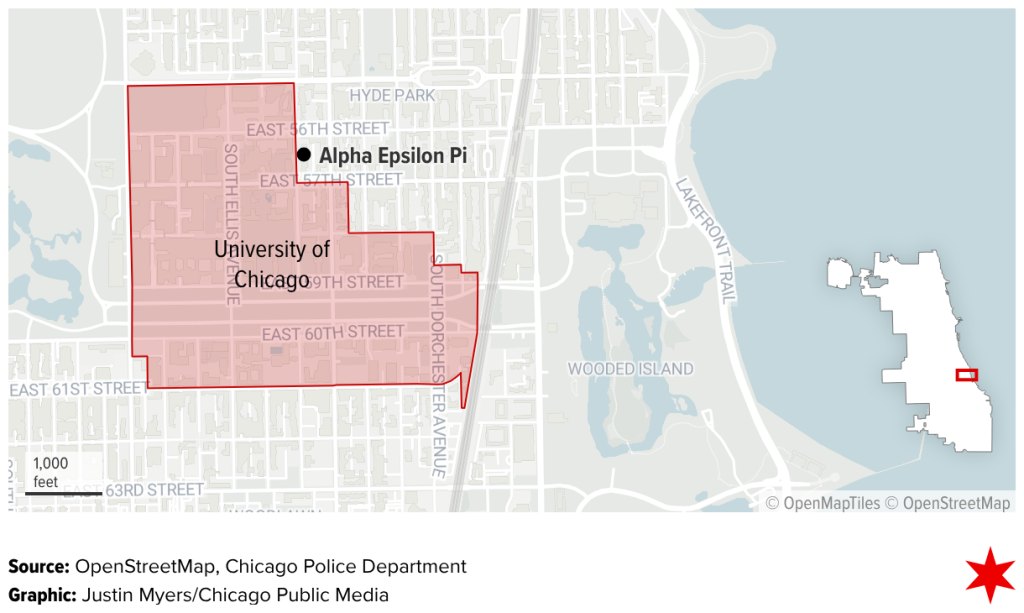
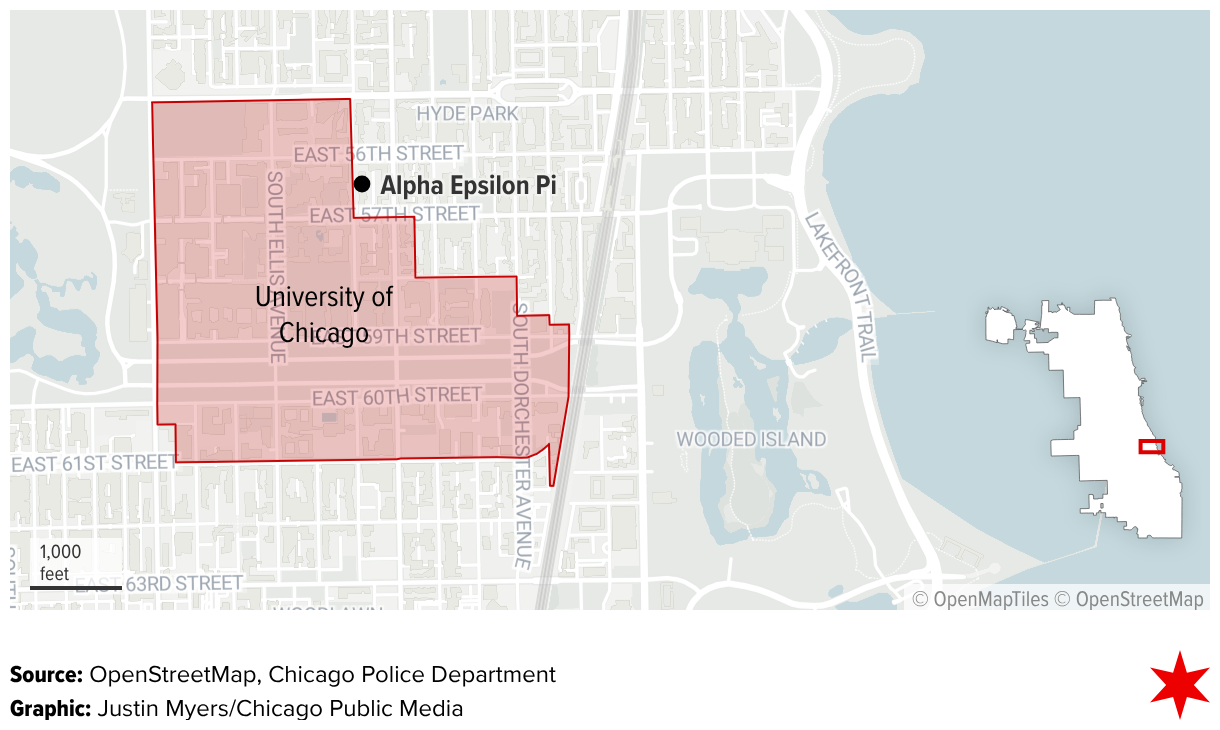
A police report first obtained by the Chicago Sun-Times shows that a woman reported being assaulted early Sunday at the Alpha Epsilon Pi house, 5625 S. University Ave. Her account was backed up by two friends, who told the police they intervened by barging into a bathroom where the attack reportedly happened.
The university issued an alert Tuesday saying “a person of interest” had been identified. But on Wednesday, the Chicago Police Police Department said no one was in custody.
“The investigation remains ongoing,” the police said in a statement.
The university alert says the man accused of the assault doesn’t attend the school. Neither does the woman who says she was attacked, according to the police report.
The assault was reported amid a nationwide firestorm over sexual violence on college campuses, spurred by a reported gang rape at a fraternity house at Cornell University in upstate New York.
Christina Zuba, a managing attorney at the Chicago Alliance Against Sexual Exploitation whose work focuses on student survivors, said she was saddened and frustrated — but not surprised — after reading about the reported assault at the University of Chicago: “This is what is happening on college campuses everywhere.”
“I am not surprised to see systems and institutions not doing all that they could for survivors because I see that every day in my work,” she added.
Reports of rape and fondling on- and off-campus at the University of Chicago have fluctuated in recent years, according to university disclosures required under federal law. There were four reports of each crime last year.
So far this year, the University of Chicago police have received five reports of sexual assault, a crime defined more broadly than rape.
The university didn’t respond Wednesday to requests for comment and an interview with Paul Alivisatos, the president.
The University of Chicago previously said it “remains committed to addressing sexual misconduct cases that occur, to imposing disciplinary consequences as warranted, and to continually improving efforts to prevent sexual misconduct.”
The man accused of sexual assault has been barred from the campus, the alert says.
Fraternity under scrutiny
His accuser went to the fraternity party with two friends and met the man on the dance floor, where he repeatedly invited her to a bedroom, according to the police report.
After she refused, she began to feel “unwell” and went to the bathroom, the report says. He followed her inside and sexually assaulted her as a group of men cheered outside, according to the report.
Her friends eventually forced their way into the bathroom and found the woman was “not fully conscious,” the report says.
The case places another harsh spotlight on Greek life at American universities.
Fraternities are not recognized as official student organizations at the University of Chicago, and therefore have no formal affiliation with the school. Still, members of fraternities, who are University of Chicago students, are subject to the school’s disciplinary policies.

The university has said it “will continue to determine whether violations of University policy occurred, and will initiate disciplinary actions as warranted.”
The fraternity’s national headquarters believes none of its members were “involved or complicit” in this incident.
The University of Chicago chapter of Alpha Epsilon Pi previously made headlines in 2016, when leaked emails revealed the racist internal conversations of its members.
In one email, a member said he was planning to celebrate Martin Luther King Jr. Day by drinking, eating at a fried chicken restaurant and watching a film that parodied the blaxploitation genre, according to Buzzfeed.
Fallout from Cornell
University of Chicago students said the Cornell case was already front of mind when they learned of the reported attack in their own backyard.
Nick Klugston, a graduate student in his first year of a social sciences program, said there should be more in-class discussion about sexual violence. He questioned whether people from outside the university were coming to parties to prey on women.
“Are we creating these spaces where it’s easy to engage in these crimes and take advantage of people?” Klugston said.
What happens after someone reports an on-campus assault is “opaque,” according to Zuba, who said survivors are often forced to weigh whether it’s worth enduring an investigation with “no guaranteed outcome.”
“Often, these cases take the entire school year to resolve,” she noted.
Zuba said she worries that survivors have seen the way some have responded to the Cornell case, and that people have blamed the accuser and “torn her apart.”
“Students hear that and they will wonder: Is this what’s going to happen to me if I come forward? Will my school mishandle it? Will they care?”
For information or resources on sexual assault, go to www.RAINN.org
Contributing: Alden Loury