
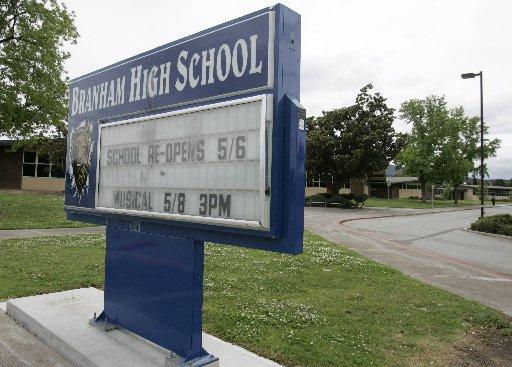
Cormac, an 18-year-old senior at Branham High School in San Jose, was on the way to his AP Government class on Oct. 4 when a fellow Jewish student showed him her phone. What he saw on it was shocking: a photo of a group of his classmates arranging their bodies into the shape of a swastika on the school’s football field.
“My jaw visibly dropped. … Within the span of 30 seconds, my emotions from shock shifted to actual anger,” said Cormac, who asked to only be identified by his first name due to the sensitivity of the situation. “What I was feeling in that moment was how disgusting it was for someone to post this on social media.
“This was an open hate crime. It wasn’t subtle. It wasn’t secretive. This was out there in the open for a lot of people to see, and it made me feel really unwelcome at school.”
The photo sent shockwaves through the high school and larger community last week after it was posted to social media alongside a quote from Adolf Hitler, prompting condemnation from school and elected officials and concern from local Jewish organizations.
The school was investigating the incident and reported it to the San Jose Police Department, which said this week that it was being investigated as a hate crime.
Cormac recalled standing in a huddle with other students, all shocked by the photo they were looking at. Many of them had the impulse to question the participants on why they would do such a thing — and tell them that their actions were not okay.
“One person would be strange, but nine to 10 people being openly antisemitic, that was just like, is this a bigger issue than I thought?” he said. “I didn’t know how many other people actually thought this.”
Cormac’s mom, Sarah, 53, was also shocked by the incident. She experienced antisemitism growing up, but she said that, even ten years ago, such an act would have been unacceptable.
“The quote is what really bothers me, also, because it’s an Adolf Hitler quote, and it’s calling for, essentially, the annihilation of the Jewish race,” Sarah said. “I just wanted to get down to: What’s going on? Is this something that’s a huge issue at Branham that’s going to start coming to light? Or is this … just (nine) stupid kids doing something for the shock value?”
Brian Levin, the founding director of the Center for Hate and Extremism at California State University, San Bernardino, said that there has been a large increase in hate crimes in recent years but that 2025 is on track to have fewer than 2024. In San Jose in 2024, there were 116 hate crimes, six of which were antisemitic. As of October 2025, there had been 68 hate crimes, four of which were antisemitic. But that decrease still makes for an “elevated plateau,” he said.
Levin added that there has also been an increase in anti-Jewish hate incidences, with Jewish people reporting that they have been facing hostility more routinely. Much of that occurs online and draws on stereotypes and canards. Some uses the ongoing Israel-Hamas war to “exploit the most long-standing and vile stereotyping caricatures against Jews.”
Social media, he added, “has descended into a cauldron of stereotyping, conspiracy and aggression.”
Maya Bronicki, education director for the Bay Area Jewish Coalition, added that young people often “don’t understand that social media doesn’t give them the exact true information, and that they are now hurting peers at their school and spreading more hate and more harm.”
To combat antisemitism, “education is key,” Levin said.
“People are very much uneducated with respect to historical events and instances of mass prejudice, for instance, whether it’s the Trail of Tears or the Holocaust,” he said. “It’s important for it to be a whole society approach, by the way, that says … this is not just something that’s anathema to Jewish people. This is something that’s anathema to the pluralistic democracy that we aspire to be.”
Cormac said that he has had conversations with students at school who do not believe that six million Jews were killed in the Holocaust.
“The issue with this is that they’re uneducated, and this is where that stems from. They’re uneducated in the fact that they don’t understand that this is morally and legally unacceptable. This is an outward hateful act towards not just Jews, but people of color, people in the LGBTQ+ community,” he said. “There were people who made the human swastika who … would have been persecuted by the Nazis.”
Sarah, who grew up in a town where older Jewish people had numbers tattooed on their arms from the concentration camps, said that there was “no questioning” whether they were Holocaust survivors. When people do not see that, “you get people that don’t believe it.”
BHS is planning to work with local Jewish organizations, including the Anti-Defamation League, the BAJC and the Jewish Community Relations Council of the Bay Area, to implement educational approaches on the Holocaust, antisemitism and hate speech and symbols. The education began with a presentation on the meaning of antisemitism, Cormac and Bronicki said. But some students walked out during the lesson, saying the photo was exhibiting free speech, Cormac added.
Bronicki added that only about 26% of schools in California have proper Holocaust education, and that at some schools, “Holocaust lessons are being weaponized against Jews” to further a political agenda. That, said Tali Klima, spokesperson for the Bay Area Jewish Coalition, is “another form of antisemitism that is especially horrifying to many of us who are third generation survivors.”
Cormac is worried that, if the school takes the time for education on antisemitism, high school students may see that as a result of Jewish community “complaining too much.” He hopes that the school gives some smaller slideshows and educational experiences to the whole school community and give students the choice to participate in further educational opportunities.
As for the students who made the swastika: “I want to see them make an apology, not to myself or the Jewish community, but everyone as a whole,” he said. “I want them to sit down with rabbis. I want to see them sit down with members of the LGBTQ+ community and people of color, and I want them to understand and learn how each group that was marginalized and oppressed in the Holocaust.”
Sarah would like to see BHS “do the same important work that they do with other marginalized communities that have hate that go against them.”
“When you allow hate,” she said, “hate breeds hate.”